Exact Match in Facial Recognition Search: What Does It Mean?
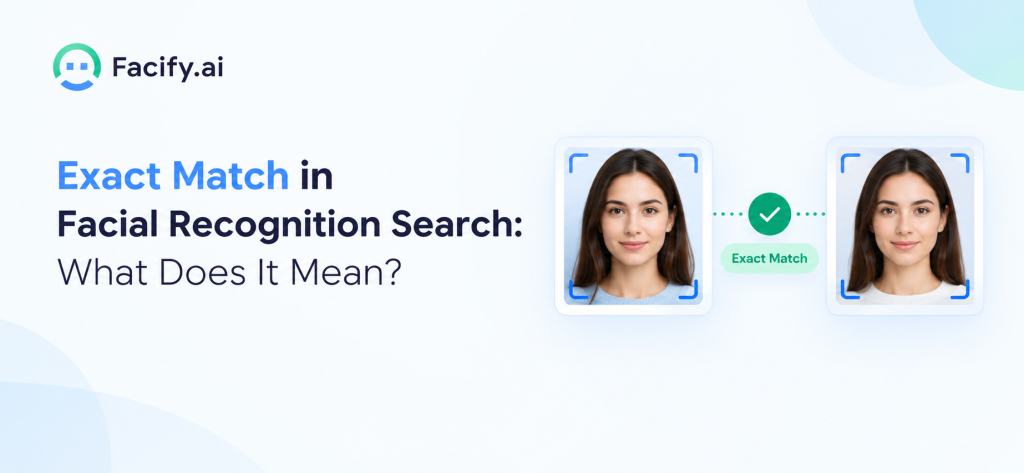
Facial recognition is an outstanding technology. It benefits lots of people. Some use it simply to unlock their mobile devices. Some use it to identify fake profiles and catfishing attempts. And many use it to identify people from their photos.
In recent years, this technology has gone through a major revolution. With the help of AI, modern facial recognition systems provide exact matches almost every time. That’s why more and more people are using it today.
Let’s learn more about the technology and understand what exact matches are!
What Is an Exact Match in Facial Recognition?
An exact match in facial recognition search usually means that a system found a face with a high similarity score. In other words, the person in the uploaded photo and the output are the same.
To enhance accuracy, most systems turn visible facial features into a mathematical face template. The template stores numerical patterns that represent features and their relationships rather than saving a written description of the face.
The software then compares the templates and produces a similarity score. A preset decision threshold determines which scores count as matches, so the meaning of “exact” can vary between systems and search settings.
Benefits of Exact Matches in Facial Recognition
Strong facial matches can narrow a large search quickly and help users focus on the most relevant results. Their value grows when clear images, suitable thresholds, and reliable reference data support the comparison.
The main practical benefits include:
- Faster Candidate Review: Helps users focus on the strongest returned facial candidates.
- Reduced Search Burden: Limits time spent reviewing weak or unrelated results.
- Clearer Prioritization: Places high-scoring comparisons ahead of lower-scoring candidates.
- Better Verification Support: Gives reviewers a stronger lead for further checks.
- Consistent Decision Rules: Applies the same scoring threshold across comparable searches.
Technical Process Behind Exact Matching
Image Input
The whole process starts with a single input. You have to access the face search tool and provide it with a photo to conduct facial recognition search. The tool first spots the face in the photo. Then, it separates it from the background and other objects in the image.
The tool also checks basic image conditions, including face size, sharpness, pose, and lighting. A clear, front-facing image usually gives the later comparison stage more useful facial detail to analyze.
Face Template Extraction
After locating the face, the facial recognition system measures patterns across key facial regions. Modern tools use a neural network for accurate measurement. They convert those patterns into a face template. This template is often called an embedding.
It represents identity-related features in a compact set of numbers. It does not work like a list of eye, nose, or mouth measurements. Instead, the model learns combined patterns that help separate one face from another.
Database Template Retrieval
The search tool next retrieves stored face templates from its reference database. In a one-to-many search, the database may contain many enrolled identities or indexed face records that could match the submitted image.
Efficient search methods can reduce the number of comparisons when databases become very large. The system then sends likely candidates, or all stored templates in smaller databases, to the scoring stage for closer comparison.
Similarity Score Calculation
During scoring, the system measures how close the submitted face template sits to each stored template in its numerical feature space. The exact scoring method depends on the recognition model and software design.
A higher similarity score generally signals a closer facial relationship under that system’s scale. Users should not compare scores from different products directly because vendors may use different models, score ranges, and calibration methods.
Match Threshold Decision
A match threshold sets the minimum score that a comparison must reach. The system treats it as a possible match. Operators often choose thresholds according to the risk and purpose of the search.
Lower thresholds can return more possible matches. However, they may also raise false-match rates. Higher thresholds demand stronger similarity and can reduce false alerts, although they may also miss genuine matches under difficult image conditions.
Factors Behind Exact Matches
Facial Landmark Alignment
Facial landmark alignment helps the system place important face regions in consistent positions before comparison. Common landmarks include points around the eyes, nose, mouth, and face outline.
Good alignment reduces variation caused by head position or image framing. If landmark placement shifts because of blur, obstruction, or an unusual angle, the resulting template may represent the face less consistently.
Image Resolution Quality
Image resolution controls how much facial detail the system can examine. Small faces may lose useful texture and shape information after cropping or compression.
Higher resolution alone does not guarantee a match. Enough clear facial pixels can help the model capture stable features and reduce errors linked to missing detail.
Facial Angle Differences
A side-view face shows different visible features than a frontal face. Large pose changes can hide one eye, alter apparent proportions, and reduce comparable detail.
Modern models handle some pose variation. Strong angle differences can still lower similarity scores, especially when the reference image shows a centered face.
Lighting And Shadows
Uneven lighting can brighten one side of a face while hiding detail on the other. Meanwhile, deep shadows may change visible edges and facial texture.
Recognition models often handle normal lighting changes. Severe glare, darkness, or directional light can still remove useful information and weaken the comparison.
Expression And Pose
Smiles, frowns, open mouths, and raised eyebrows change parts of the face that recognition models examine. Similarly, large expression changes can shift local features.
Moreover, pose creates additional variation during comparison. Remember, a neutral, forward-facing reference usually gives the system a steadier basis than an exaggerated expression or unusual head position.
Conclusion
Readers should treat an exact match as a strong system-level similarity result, not automatic proof of identity. The label depends on the face template, comparison score, database, and threshold that a particular system uses. Image quality also shapes the outcome. Resolution, pose, lighting, facial alignment, and expression can strengthen or weaken the score under different conditions. For reliable use, match labels should support careful review rather than replace it. A facial search result gains meaning when users consider the source image, system settings, and other available evidence before reaching a firm conclusion.